
Liquidation Price: What It Is and Why Traders Should Care
Learn what liquidation price is, why it matters in leveraged trading, and how traders can avoid forced liquidation and losses.
The liquidation price is the market price at which a leveraged position is forcibly closed by the exchange because the trader’s margin can no longer cover losses.
Once the liquidation price is reached:
The position is closed automatically
The trader loses most or all of the margin
The trade cannot be recovered
Liquidation protects exchanges from negative balances but exposes traders to sudden and total losses.
Why Liquidation Happens in Trading
Insufficient Margin
Liquidation occurs when a trader’s account margin falls below the maintenance margin required to keep the position open.
High Leverage
The higher the leverage, the closer the liquidation price is to the entry price. Even small price movements can trigger liquidation.
Market Volatility
Cryptocurrency markets are extremely volatile. Sudden price spikes or crashes can push prices to liquidation levels within seconds.
Liquidation Price vs Stop-Loss
Key Differences
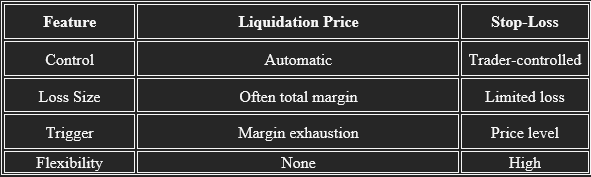
A stop-loss is a risk management tool, while liquidation is a failure of risk management.
How Liquidation Price Is Calculated
Basic Factors in Liquidation Price Calculation
Liquidation price depends on:
Entry price
Leverage used
Initial margin
Maintenance margin
Trading fees
Each exchange uses a slightly different formula, but the concept remains the same.
Liquidation Price Formula (Simplified)
Long Position
Liquidation Price ≈
Entry Price − (Initial Margin − Maintenance Margin) ÷ Position Size
Short Position
Liquidation Price ≈
Entry Price + (Initial Margin − Maintenance Margin) ÷ Position Size
The higher the leverage, the smaller the distance between entry price and liquidation price.
Example of Liquidation Price in Crypto Trading
Long Trade Example
Entry Price: $40,000
Leverage: 20×
Margin: $2,000
Maintenance Margin: $1,200
A small 5% market drop could push the price to liquidation, wiping out the position.
Short Trade Example
Entry Price: $30,000
Leverage: 15×
Margin: $2,000
A rapid price spike can liquidate the trade within minutes during high volatility.
Liquidation Price in Leveraged Crypto Trading
Why Crypto Traders Face Higher Liquidation Risk
Crypto markets operate:
24/7
With extreme volatility
With high leverage options (up to 100×)
These conditions make liquidation more frequent than in traditional markets.
Liquidation Cascades
When many traders are liquidated simultaneously, it can trigger liquidation cascades, accelerating price crashes or spikes.
Impact of Fees on Liquidation Price
Hidden Risk: Fees Reduce Margin
Trading fees and funding fees reduce available margin, effectively moving the liquidation price closer to the current market price.
High-frequency traders and scalpers are especially vulnerable.
Liquidation Price and Risk Management
Use Lower Leverage
Lower leverage increases the distance between entry price and liquidation price, giving trades more room to breathe.
Always Use Stop-Loss Orders
Stop-loss orders close trades before liquidation, preserving capital.
Proper Position Sizing
Never risk a large portion of your account on a single trade.
Maintain Extra Margin
Keeping unused margin reduces liquidation risk during temporary volatility.
Liquidation in Isolated vs Cross Margin
Isolated Margin
Only assigned margin is at risk
Liquidation affects a single position
Better for risk control
Cross Margin
Entire account balance is used as margin
One liquidation can drain the whole account
Higher risk for beginners
Liquidation Price in AI and Algorithmic Trading
In AI trading bots and algorithmic systems, liquidation price is a key parameter.
Professional systems:
Automatically adjust leverage
Monitor margin levels in real time
Reduce exposure during high volatility
Ignoring liquidation risk can destroy even profitable algorithms.
Common Mistakes Traders Make with Liquidation Price
Using maximum leverage to chase profits
Ignoring maintenance margin requirements
Not accounting for fees
Holding positions during major news events
Overconfidence after winning streaks
These mistakes dramatically increase liquidation risk.
How to Avoid Liquidation as a Trader
Best Practices
Use conservative leverage
Set stop-loss orders immediately
Monitor funding rates
Avoid trading during extreme volatility
Keep risk per trade below 1–2%
Professional traders prioritize survival over profits.
Why Liquidation Price Matters for Long-Term Success
Liquidation resets a trader’s account to zero. Recovering from a full liquidation is emotionally and financially difficult.
Traders who understand and respect liquidation price:
Trade more consistently
Preserve capital
Stay in the market longer
Build sustainable strategies
The liquidation price is one of the most important concepts in leveraged trading. It defines the boundary between controlled risk and total loss. Whether trading cryptocurrencies, futures, or forex, ignoring liquidation price can lead to devastating results.
By understanding how liquidation price works, using proper risk management, controlling leverage, and applying stop-loss strategies, traders can protect their capital and improve long-term performance in volatile markets.
Mastering liquidation risk is not optional—it is essential for every serious trader.